
No products
Prices are tax included
Product successfully added to your shopping cart
There are 0 items in your cart. There is 1 item in your cart.
Archéologie et Histoire Romaine
- Archéologie et Histoire Romaine
- Archéologie Moderne et Contemporaine
- Archéologie des Plantes et des Animaux
- Archéologie du Paysage
- Archives & Histoire de l'Archéologie
- Europe Médiévale
- Monographies Instrumentum
- Préhistoires
- Protohistoire européenne
- Research Protocols
- Off collections
- Résonances
- Les cahiers de saint-michel de Cuxa
- Second-hand
 View larger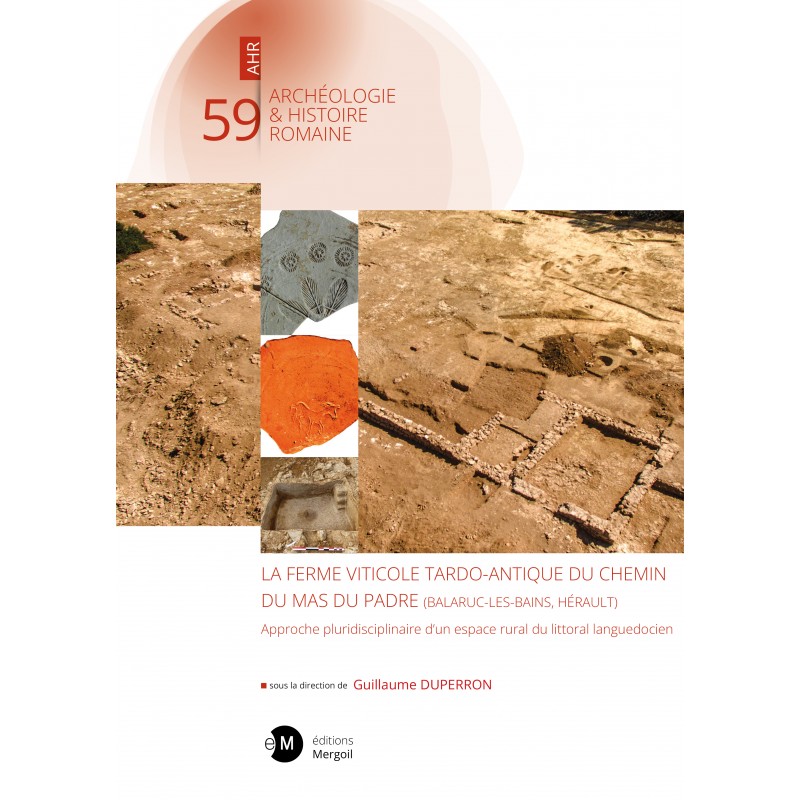
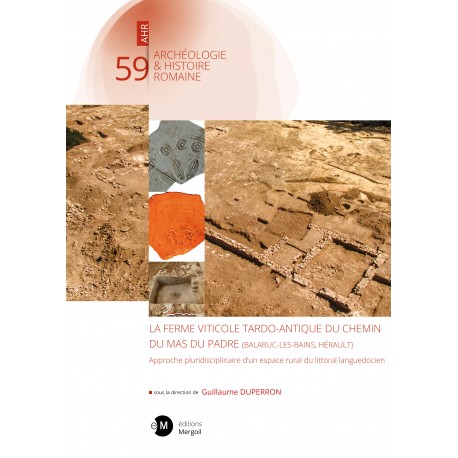
La ferme viticole tardo-antique du chemin du Mas du Padre (Balaruc-les-Bains, Hérault)
AHR-59
New
La ferme viticole tardo-antique du Chemin du Mas du Padre (Balaruc-les-Bains, Hérault). Approche pluridisciplinaire d'un espace rural du littoral languedocien
Sous la direction de Guillaume Duperron
Edition Details
- Layout and Graphic Design : Guillaume Duperron
- Cover : M. Peyrière (photo aérienne), G. Duperron
- Preface : Christophe Pellecuer
- Printer : Aquiprint
- ISBN : 978-2-35518-164-1
- Legal Deposit : mai 2026
- Language : french
Book Specifications
- Year : 2026
- Number of Pages : 328 pages dont coul. et A3.
Cet ouvrage est publié avec le soutien du Défi Clé Sciences du Passé, initié et soutenu par la région Occitanie et porté par la COMUE de Toulouse, du LabEx ARCHIMEDE dans le cadre du programme France 2030 - ANR-11-LABX-0032-01 et de l'UMR 5140 ASM.
More info
Resume
In central Languedoc, a short distance from the shores of the Étang de Thau, the site of Chemin du Mas du Padre represents one of the rare Late Antique rural establishments in Mediterranean Gaul to have been the subject of a comprehensive archaeological investigation.
Excavation revealed the remains of a building of approximately 500 m2, constructed ex nihilo at the beginning of the 5th century AD and equipped with two pressing installations intended for wine production, associated with storage cellars whose capacity may have reached several hundred hectolitres.
The abundant artefactual assemblages attest to a dynamic economy, still largely monetised and integrated into regional as well as transmarine exchange networks, particularly with Africa and the Eastern Mediterranean.
The continuation of occupation for nearly a century after the abandonment of wine production, in the first half of the 6th century, provides an opportunity to observe the transformations in material culture that accompanied the transition to the Early Middle Ages.
Based on a broad multidisciplinary approach, this study benefits from a micro-regional perspective informed by the rich body of documentation available for this sector of the Languedoc coastline.
The volume thus offers new insights into the economy of a Mediterranean rural area at the end of Antiquity, highlighting in particular the continued importance of viticulture during this period.
.
Summary
Préface
Introduction
Chapitre 1 – Les données de terrain
Chapitre 2 – Les mobiliers céramiques
Chapitre 3 – Étude archéométrique des céramiques africaines
Chapitre 4 – Étude des verres
Chapitre 5 – Étude de l’instrumentum
Chapitre 6 – Étude de la meule
Chapitre 7 – Les monnaies
Chapitre 8 – Les tuiles en terre cuite
Chapitre 9 – Analyses biochimiques du contenu des bassins
Chapitre 10 – Archéozoologie d’un établissement rural du Bassin de Thau entre Antiquité et Moyen Âge
Chapitre 11 – Paysage végétal, charbonnage et arboriculture sur les rives de l’étang de Thau durant l’Antiquité tardive d’après l’étude des charbons
Chapitre 12 – Synthèse et mise en perspective des données :
Le Barrou à Sète : le devenir d’une villa littorale à la fin de l’Antiquité
Une installation viticole tardo-antique dans l’agglomération de Balaruc-les-Bains
Le Fiau : un établissement rural du Haut Moyen Âge
Conclusion
Bibliographie
Authors :
Marie Anselmo, Iouri Bermond, Fabrice Bigot, Aurélia Borvon, Claudio Capelli, Alain Chartrain, Vianney Forest, Nicolas Garnier, Jordan Latournerie, Marie-Laure Le Brazidec, Delphine Lopez, Cyprien Mureau, Christophe Pellecuer, Antonia Persico, Hervé Pomarèdes et Christophe Vaschalde
Download
Customers who bought this product also bought:
30 other products in the same category:
-
Du Rhône...
-
L'Urbanisme...
-

Romanisatio...
-
Les...
-
La Maison...
-
L'Empire...
-
Javols-Ande...
-
Les...
-
Pratiques...
-
Etudier les...
-
Du Rhône...
-
Archéologie...
-
La...
-
L'organisat...
-
Le Clos de...
-
Le centre...
-
Abécédaire...
-
Urbanisme,...
-
Histoires...
-
Arquitectur...
-
De silex,...
-
Un quartier...
-

Lugdunum et...
-
STRUCTURES...
-
LES...
-
La...
-
Archéologie...
-
La forme de...
-
Production...
-
The...